
This was our first year on homeschooling. Our two children, Owan (10 years old) and Luke (8 years old) had many of their activities performed together. However, I took care to personalize information for each of them. During some other activities, they were totally separated.
For example: reading practice is at the same time, but with different books for each of them. Likewise, I teach them both mathematics and grammar, and while some basic information is common, most is different, and eventually they have different exercises. At the piano classes, however, they go separately.
Environment
In our house we have the entire attic chamber as a dedicate space for study / learning / creative activities. This light-full space is organized with children in mind, pretty much based on Waldorf principles, with many natural materials and areas where they can enjoy free play.

Also, inspired from Montessori approach, this space, and the garden as well, are filled with various elements in order to create a “prepared environment”, where they can freely experience different activities, in order to fulfill their developmental needs.
The pace of our activities is relaxed, following as much as possible their natural impulses, with taking care to let them have enough time at their disposal, for free study/play, in areas of their interest. I followed their tendecy to link what they have learned with these free activities. One advantage of homeschooling is that we (parents) can make sure that children are not tired. The schedule is flexible enough to ensure that they sleep enough and have enough recreation time for their age, this also being correlated with the activities performed (during the week and week-end). An other major issue is that we can really watch what and how (well) they eat. It is the perfect place and time to teach them about nutrition and the good eating habits.

More general, one can see that teaching (of a homeschooler) goes together with fulfilling the (Maslow’s) hierarchy of needs: physiological, safety, love/belonging, esteem and, certainly, self-actualization, with creativity, acceptance, morality. And most of all, we make sure that learning is made on positive and healthy emotional foundation.
Disciplines
This year we have been focused on the following disciplines:
• Romanian Language ( Reading / Writing / Grammar )
• Mathematics
• Sciences ( Biology / Physics / Chemistry )
• History
• Arts ( Drawing / Music )
• Foreign Languages ( German / English )
• MindLab
• Sports ( Swimming / Karate / Football )
I chose and presented these in such a way that the entire information goes interconnected. That makes sense for their minds and is more simple to be assimilated.
• Performed at home:
Reading, Writing, Grammar, Maths, Biology, Physics, Chemistry, History, English
• Performed at organized groups / clubs :
Drawing, Music, German, MindLab, Swimming, Karate, Football (European)
In the following sections there is a short description of children’s activities and accomplishments for each discipline.
Romanian Language
Activities related with Romanian (mother tongue) are core disciplines for us, because, not only the socialization, but also most information is gathered using Romanian language. In the past, while attending a German language school, there were some difficulties in absorbing grammar for example, whereas using Romanian, it all comes simple and natural for our children. As a second step we compare learned concepts with German and/or English sentences.
Reading
The children do read every day. I still have sessions when I sit with one of them and have him reading loud. Sometimes I take the read, in order to emphasize the intonation. But most of times I let them read alone, silently. They already do it fluently. For the time being they choose whatever book they wish, from a given library. I am
following mainly how much they can concentrate on this activity. The aim is to have it made with ease and pleasure.
OWan (10 years old) reads Alexandre Duma’s “The Three Musketeers” (translated in Romanian, obviously). It is rather intricate for his age. He sometimes asks for the meaning of some words. He can easily stay focused for 30 min. Thus I ask him to read each day for at least 20 min. Most of times, though, he reads more, as he wants to finalize the paragraph or chapter. (It also depends on the difficulty of the chapter.)
Luke (8 years old) reads various short stories and articles, mainly from scientific and history children books (having many images). The latest is about dinosaurs. His reading time is a minimum of 15 min. every day. In most days he can easily stay focused for 20 min or more.
Writing
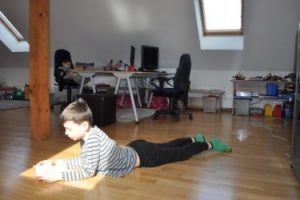
Writing is a sensitive issue at this stage and I declared it as my main concern this year. At the beginning of the school year OWan (10 years old) found writing difficult and unattractive, while I found his writing inefficient (wrong posture) and rather ugly. Beauty of writing is not necessarily an issue, but the fact that he did not follow the lines was indicating some sort of unconcern or lack in his abilities. Although he managed to write the letters (characters) correctly, sometimes he had troubles with linking them cursive in hand writing.
During his previous school year (in the public school) Luke (8 years old) had serious problems with writing. He is ambidextrous and initially he started writing with his left hand. Although drawing and coloring went fine, he eventually failed in using the pen. I tested him with right hand, as well. He was doing quite well, but much slower. Therefore, at the beginning of this school year, we have decided (after weeks of tests and analysis) that is time for him to learn writing carefully with his right hand !!
So I started to teach calligraphy. And tried to make it interesting. We compared alphabets around the world. Their letters and their sounds. We even invented an alphabet (inspired from Montessori approach). We compared advantages and disadvantages of capital vs. small and printed vs. handwritten letters. Made incursions in the history of writing and languages. Used different colors and pens. Different papers. Combined with various grammar issues and funny phrases. And so on, and so forth … Complementary, we have also attended drawing classes (see activities below).
Corrected their body posture and, related with spine health, we started swimming classes. All together, with patience and imagination, we managed to achieve remarkable results. Filled a gap in this area, where we were a little behind (compared with regular schools).
Grammar
Grammar has been one of the major steps forward. This was the first year when we studied grammar systematically.
My first problem was to make it alluring and make children think / use of it in real life (i.e. when writing or when learning a foreign language).
The children kept asking me what is grammar useful for. So, I shared them my experience and explained why is it interesting for me, personally. And took advantage to make parallels between a number of languages. For them, that was both interesting and impressive. Then (with the help of Internet) I presented funny expression and situations
where words and writing go tricky and could create confusions in Romanian.
Then, in time, we went to pens and colored ink and started sentences. I presented grammar rules, but rather then asking them to learn those rules, I emphasized the idea of order and clarity. Lessons were not longer than 15 min, and the exercises were meant to give pupils some sort of satisfaction, when discovered general rules within particular situations. Gradually, grammar became one of the favourite classes. Exactly because it became so … simple and easy to handle. I even used grammar to get them involved in writing exercises. This is when classes of Romanian Language become a pleasure for the teacher, as well. From here, there are still lots to learn in grammar. But important is that there is confidence and we can use this as a support for other activities (like writing, foreign languages and, hopefully, maths).
Mathematics
This is one of our favorites (children’s and mine). I did teach them maths in the years before; I even made maths presentations in their previous school, where they also had good maths performances. I have very specific objectives when teaching mathematics and there are some values I want to transfer (on long term), as described below.
For me, this is much much more than teaching numbers. It is making pupils understand that mathematics is a tool that is immensely useful, that it should be and must be enjoyable, it is made to help (not to create stress) and it is made by and for humans (hence it is supposed to be intelligible, at hand, helpful). It is for their life much more than for their exams.
I see these lessons very much in a philosophical way. Mathematics is abstract, yes, but it is a generalized reflection of reality, so it is a way of approaching existence, of understanding the world. More, it is a universal language. For example, children wrote a relation and then we imagined how our paper could be understood by a German or a Japanese person. We even discussed about how to make a message for extraterrestrial intelligence.
And further more, psychologically, maths lessons are to make children consider reasoning. Are to teach them to write proofs and to find the power of logic. They are to enhance self discipline and give them a clear conscience.

At a pedagogical level, I watched for their:
• eye-hand coordination
• vision and space representation
• precision in speaking and writing
• abstract thinking
One can easily understand how the above issues have also been watched and developed, in parallel, by our customized lessons of music (piano) and drawing (presented in coming sections).
OWan (10 years old) studied algebraic expressions including fractions, factors, powers, operations with sets, simple functions, gr.I equations and equation systems and the basics of geometry.
Luke (8 years old) studied arithmetic, fractions, sets, charts on two axis and very basics of geometry.
Science
Science is the hub where everything we do at other disciplines, get together in a grand vision about the world. This is why I am happy to say that it is an area of main interest for our children. Main lesson teached is that different disciplines, that formally are studied separately, are in fact interlinked in one big view. While I have continuously emphasized the link between mathematics and science, at this level we were, though, more focused on experiments and qualitative thinking about nature.
So, first of all, I presented “philosophia naturalis” – the philosophy of nature. Depicted how the world was seen since antiquity, what are the big questions, how our perception evolved. Thus, we had the opportunity to explore a little the history of science. Further on, we became more applied on what we know today, on facts and representations.
Biology
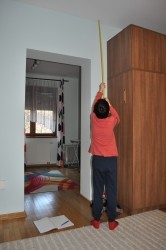
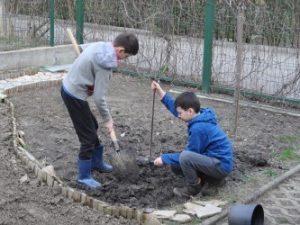
Most of our discussions were linked with direct observations of the nature (mainly, but not only, in our garden). We covered plants parts and structure, the cycle of water, oxygen and CO2 in nature, groups of animals, evolutionism.
Physics
Many experiments regarding solids vs. fluids, introduced, exemplified and discussed about the concepts of pressure, temperature, force. Explained the relation with mathematics. Introduced the first problems and ways to solve them mathematically. Also, astronomy.
Chemistry
At this stage we were already able to introduce a lot of theoretical concepts and to play with them. Learned the structure of atoms, of nuclei and the atom shields, the periodic table, the nature and types of chemical bonds. Exemplified with many elements. Drawings and presentations of results. Introduced quantitative approach and
mathematics, using the atomic number and atomic mass.
History
This year we covered antiquity, starting with human migrations and river civilizations, until the downfall of Western Roman Empire (actually, even further, because of children’s insistent questions). History is found very alluring when is presented like a story. Children are curious about other times, about kings, warriors, empires. Also about issues like ancestry, what life was like, how people understood the world. So, for this age of our children, we kept in this story like atmosphere, with introducing the timeline in most of the tales. We have also drawn different political maps of those times. Combined all these with geographical information.
Arts
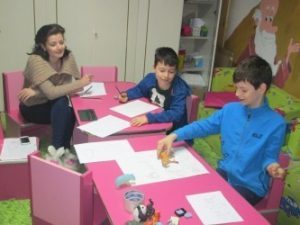
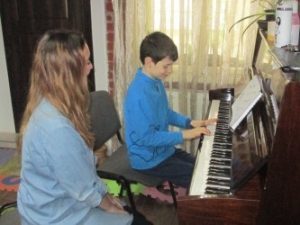
The children attended in town, once a week, classes of drawings and piano with specialized teachers. As explained in above paragraphs, these classes were carefully chosen and even customized in order to have the exercises being complementary with the ones made during the lessons of writing and maths. Nevertheless, these were also
meant to give them the possibility to find ways to express themselves.
Drawings and Piano
The piano classes were a continuation of the activity started in previous years. At drawing classes we only used pencils and got focused on dexterity and spacial representation. All together we watched for eye-hand coordination, visualization, precision in writing and abstract thinking. And all these in a creative and enjoyable atmosphere.
Foreign Languages
German
Children joined classes of German Language. The course was focused on conversation and social interactions. They had the chance to be here with other of their friends.

English
This year we studied English using a manual based on conversation. Here we were focused on improving the vocabulary and on pronunciation. Reading exercises were also extensively used.
MindLab
Both children are participating, once a week, at MindLab classes. This is a method that uses games (mainly logical games) in order to develop cognitive, emotional and social skills. We have also been involved in MindLab Olympics, national and international events organized by this association.

Sports
Children have enjoyed a variety of sports during the entire year. Karate, swimming and football are the disciplines that were practiced with trainers/teachers at organized clubs.

But also practiced in spare time, with friends. There’s no pause when comes to sports.

Conclusions
Homeschooling gave us the possibility to customize children’s activities, to notice whether there are any gaps, to be the models that they unconsciously seek at this age.
This is how we managed to have our children:
• focused on issues that initially seemed particularly difficult
• experience passions with much joy and no restrictions
• build confidence and an attitude of respect
• find self discipline within their liberty of choice
* * *
They both are particularly good at maths and precise sciences, activities made with pleasure.
They both still have to improve on writing skills.
Reading is fine, though, we will continue to watch this aptitude in order to improve it and extend its fluency onto other languages.
We will have to continue to develop their self confidence together with emotional intelligence and social skills.
As parents, although we have degrees in applied sciences and psycho-pedagogy, we also keep reading and learning mainly (but not only) about intellect, psychological transfer, needed skills, and phases of a child. For now we are mainly developing in children the basic skills: motric, intellectual, emotional, social.
The ultimate goal of our homeschooling approach is to have our children find their passion and determination to
STUDY ON THEIR OWN,
within a moral (philosophical) view of the relation between Self and World.


